
Severe winters in Rhode Island require a furnace that provides constant heat without waste of energy. What AFUE rating is best for furnaces in Rhode Island?
The appropriate furnace efficiency must be 92-97% AFUE in the Rhode Island winters. Increased ratings mean less fuel goes to waste, and this is important when the temperature is below freezing in Providence. High-efficiency gas furnace models certified by ENERGY STAR are the best in value.
This profession guides Rhode Island homeowners to choose the most efficient home heating system that will result in savings on the cost of a gas furnace with long-term savings on its efficiency ratings.
Understanding AFUE Ratings and Why They Matter in Rhode Island
Annual Fuel Utilization Efficiency (AFUE) is the percentage of the fuel energy that is converted to useful heat compared to the wasted energy. A 95% AFUE furnace is one that utilizes 95 percent of the gas to produce heat and only 5 percent as exhaust.
The older units with 80% AFUE use more power, which elevates bills with energy prices. High AFUE requires high-level features, including secondary heat exchangers and variable-speed blowers.
These will enhance energy-efficient furnace RI because it will not constantly need to cycle in order to produce the same output. Look at the labels when purchasing in order to make specific ratings.
Ideal AFUE Rating for Cold Winters in Rhode Island
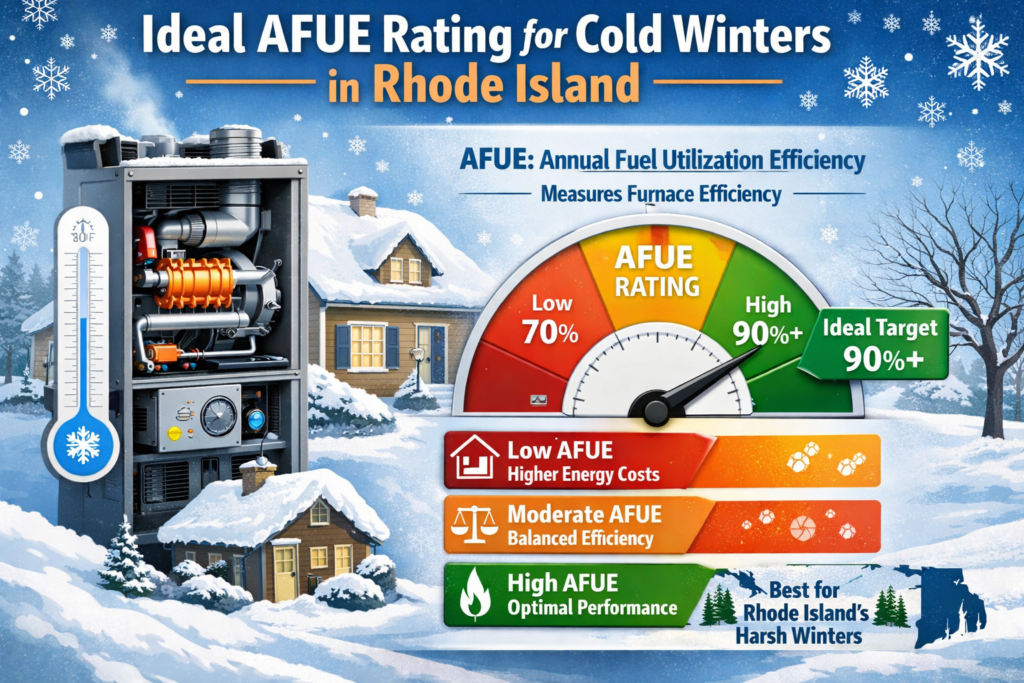
AFUE rating for cold climates – It should be 95% or more for cold areas. Furnaces struggle with sub-zero wind chills in Rhode Island during the winter months. 92-94% of models are suitable for medium budgets and 96-98% of models suitable for extreme cold.
These gas furnace efficiency rating options are high efficiency, and they recover exhaust gas heat, which is important in systems that run continuously. 80-85% lower ratings are less efficient but not as effective when the weather is colder.
Rhode Island Climate Zones and Furnace Efficiency Needs
- Rhode Island contains coastal and non-coastal areas, and each area needs a certain furnace efficiency in its design.
- Coastal Providence’s damp climate requires high-AFUE units that are non-corrosive with a rating of 93 and above.
- Winters in Warwick are very brutal, thus furnaces with 95 percent are required to retain heat.
- The total heating degree days per year are 6,000 or above in all zones, and this enhances the impact of AFUE.
- ENERGY STAR baselines of 92% will have rebates, but locals are struggling to get 95% ROI in less than 7 years.
- Older homes that are duct-sealed enhance profits.
- HVAC professionals: Zone-matched Rhode Island home heating systems.
Minimum AFUE Requirements for Furnaces in Rhode Island Homes
- Federal regulations have established a minimum AFUE of 80 percent on noncondensing furnaces in Rhode Island since 2015.
- According to local HVAC standards, installed units in particular locations should have at least 90% AFUE and higher.
- Providence needs 92 percent ENERGY STAR rebates. The ratings of oil furnaces vary, although gas is the most preferred.
- Non-compliant equipment invalidates the warranties as well as insurance. Always verify with a licensed contractor.
- Upgrading exceeds minimums for future-proofing amid carbon regulations.
How Rhode Island Energy Costs Impact Furnace AFUE Choices
- Rhode Island gas is priced at $1.50 per therm, and AFUE jumps are essential.
- The furnace with 95 percent efficiency will save 15 percent of fuel, or 350 dollars in typical households per year.
- The volatile pricing increases the returns; 2025 volatiles touch 20%.
- Buy smart thermostats and high AFUE models and get a 10 percent discount.
- Follow up on National Grid bills. Increased initial payments buy silence against rate increases.
Best AFUE Furnace Options for Older Homes in Rhode Island
To address the lack of insulation and duct losses, the older houses in Rhode Island need an AFUE of 93 percent or higher.
Basements with limited space dimensions should be fitted with two-stage models with a 94% AFUE. The variable-speed models have 96-percent AFUE with zoning control. It is best not to overdo it except when the demand is high (around 98 percent).
Duct retrofitting increases effective efficiency by 15 percent. Acorn Oil can modify furnace systems to meet modern requirements, whereas in Victorian houses, small units of 95 percent are usually favored.
Choosing the Right Furnace Contractor in Rhode Island for High AFUE Systems
Select HVAC professionals, who are certified by the NATE organization and possess the experience of the installation in Rhode Island. Ensure that the professionals have Gas Safe or Rhode Island licenses and sufficient insurance coverage.
You will require a Manual-J load calculation to confirm accurate sizing. Look at the customer feedback that commends their rapid service. Request quotes from three or more providers and evaluate the warranties provided.
Conclusion
What is the best AFUE rating of furnaces in Rhode Island? This information would be useful for you.
For this, to know more about winter heating efficiency in Rhode Island, expert guidance is required to strike a balance between climatic conditions, economic considerations, and available rebates.
If you are looking to repair and replace your furnace in Warren then contact Acorn Oil trustworthy services since 2005.
Frequently Asked Questions
1. What is a good AFUE rating for furnaces in Rhode Island winters?
The 95%+ is the best AFUE rating for furnaces in the Rhode Island winter. This will save 20% fuel consumption in the prolonged cold season with subzero temperatures and heavy snowfalls.
2. Is a 95% AFUE furnace worth the cost in Rhode Island?
Yes, a 95% AFUE furnace may pay back in 5-7 years with gas savings of over 300 per year, rebates as well as comfort in RI homes.
3. What AFUE rating is required by code in Rhode Island?
By federal code, Rhode Island needs a minimum of 80% AFUE but 90%+ by federal code to qualify for rebates, warranties, and ENERGY STAR compliance.
4. How does Rhode Island’s climate affect furnace efficiency?
The severe winters and 6,000+ heating degree days in Rhode Island require 92% or more AFUE in order to counter the quick heat loss.
5. Can I get rebates in Rhode Island for high-AFUE furnaces?
The state energy assistance programs of Rhode Island offer up to 800 dollars in new ENERGY STAR high-AFUE furnace rebates.